Lithium atom in 3D
Rechargeable batteries. Lithium compounds are used in rechargeable batteries and some specialist glass and ceramics. Explore the 3D model, inspect its parts and learn with guided explanations. Free on Atlas.
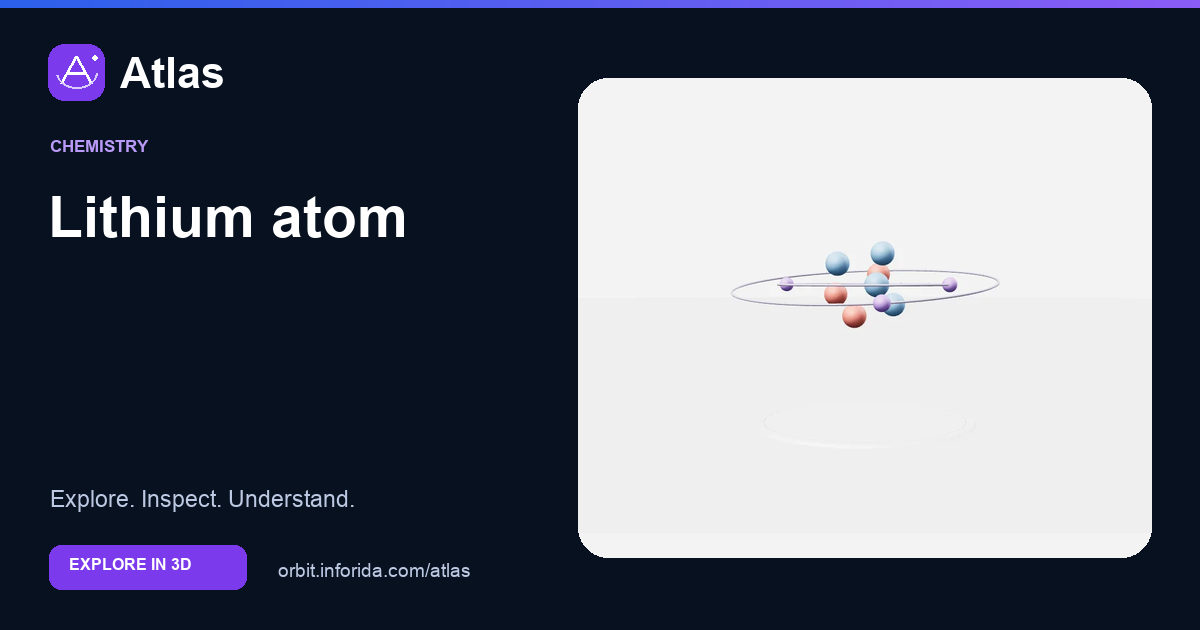
What you can learn
Rechargeable batteries. Lithium compounds are used in rechargeable batteries and some specialist glass and ceramics.
Identify lithium from its proton count.
Count the neutrons in Lithium-7.
Inspect the occupied electron shells.
Compare the valence shell with a neighbouring element.
Explain what changes when an electron is lost.
A lithium ion in a battery has different electron accounting from the neutral lithium atom shown here.
Try an investigation
Identify lithium from its proton count.
Check your understanding
What identifies an atom as lithium?
3 protons. Atomic number is proton count. Every lithium nucleus has 3 protons.
How many neutrons are in Lithium-7?
4. Neutrons = mass number − atomic number = 7 − 3 = 4. Mass number is not the average atomic weight of natural samples.
How many electrons are in a neutral lithium atom?
3. A neutral atom balances 3 positive protons with 3 negative electrons.
Which shell count describes neutral lithium in its ground state?
2, 1. [He] 2s¹ gives 2, 1 electrons across its occupied shells. Circular paths are only diagram guides.
If this atom loses one electron, what happens to its net charge?
It becomes +1. Losing one negative electron leaves one more proton than electrons. Its 3 protons still identify it as lithium.
What can this 3D shell model tell you reliably?
The particle counts for the selected neutral isotope. The counts represent a defined isotope and neutral atom. Particle sizes, spacing and circles are simplified teaching symbols.
Sources and model scope
An educational representation. The explorer identifies its data sources, scale choices and simplifications.