Graph neural network in 3D
Follow neighbour messages, aggregation and node updates. Explore the 3D model, inspect its parts and learn with guided explanations. Free on Atlas.
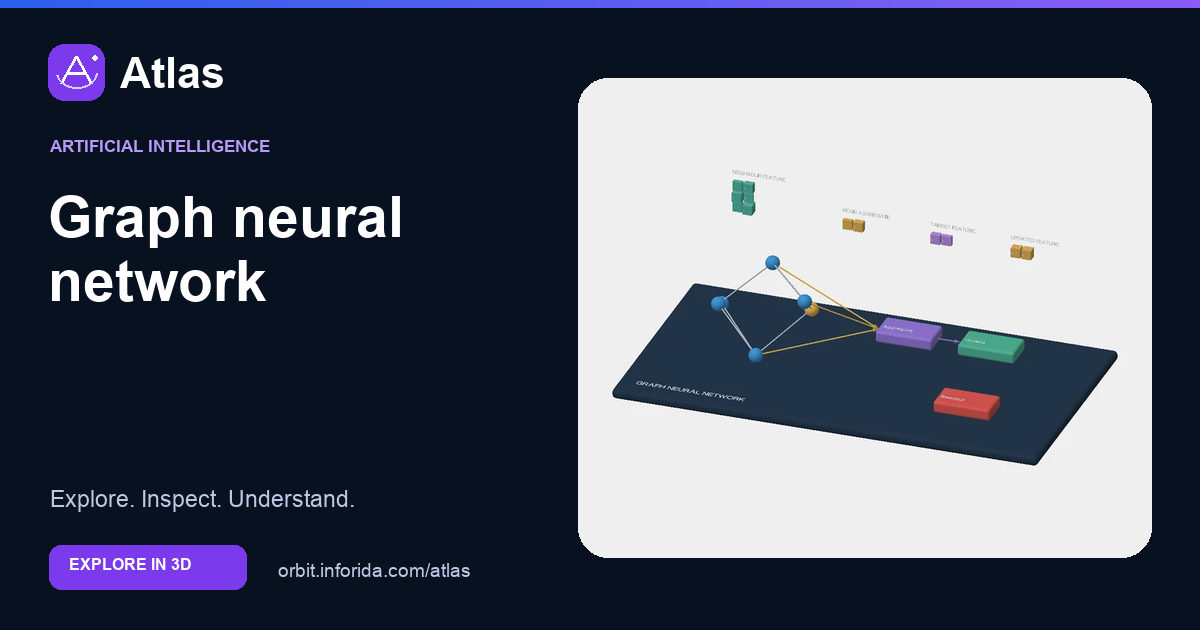
What you can learn
Follow neighbour messages, aggregation and node updates.
Start with entities and relations.
Collect from the defined neighbourhood.
Combine without depending on listing order.
Try an investigation
Trace graph structure toward permutation-invariant aggregation. Which intermediate operations or assemblies are essential, and which assumptions are simplified by this diagram?
Check your understanding
What determines a graph neighbourhood?
The supplied edges. The supplied edges. The exhibit shows computational roles and dependencies; it does not contain trained parameters or run inference.
Aggregation combines…
Neighbour information. Neighbour information. The exhibit shows computational roles and dependencies; it does not contain trained parameters or run inference.
A graph model may predict for…
Nodes, edges or whole graphs. Nodes, edges or whole graphs. The exhibit shows computational roles and dependencies; it does not contain trained parameters or run inference.
Sources and model scope
A three-dimensional computational diagram, not physical hardware or a running trained model. Displayed widths, node counts and example values are illustrative. Select named stages to trace information flow. The separate upper study rail contains deterministic worked examples, with values on every selectable cell.