Black hole & accretion in 3D
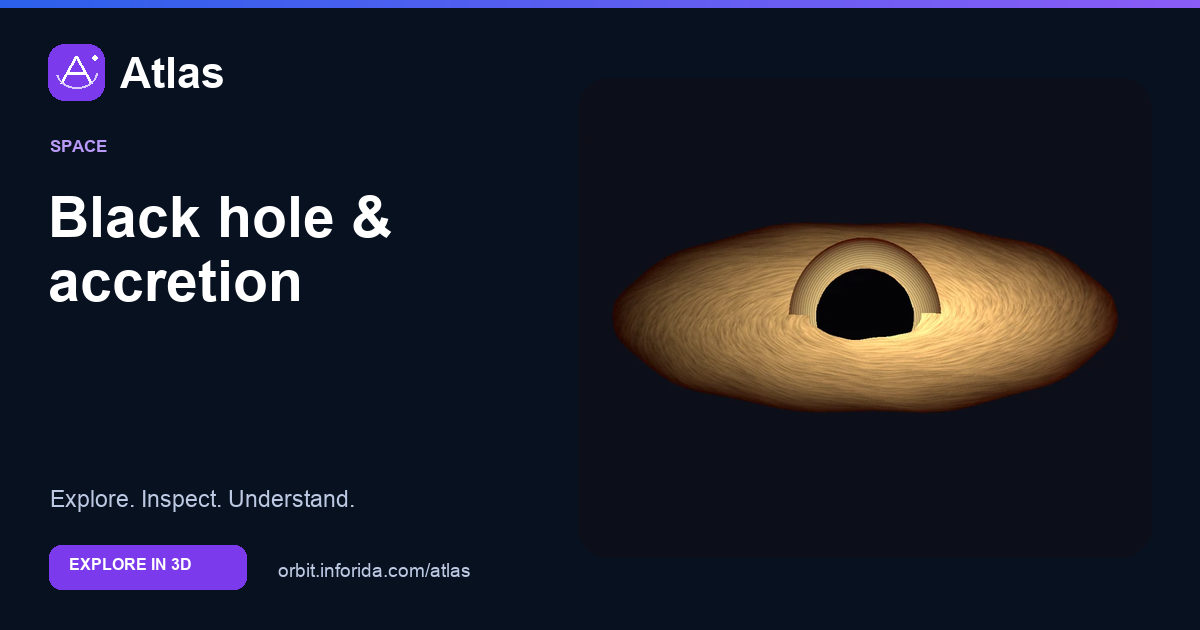
Inspect the horizon, apparent shadow, accretion flow and illustrative gravitational lensing. Explore the 3D model, inspect its parts and learn with guided explanations. Free on Atlas.
What you can learn
Inspect the horizon, apparent shadow, accretion flow and illustrative gravitational lensing.
Read the emitting material
Locate a stable-orbit limit
Separate an image from an object
Try an investigation
Compare an emitting disk patch with a lensed image of it. What is physical and what depends on the observer?
Check your understanding
Would 3 r_s be universal for every spinning black hole?
No. Spin and orbital orientation matter in Kerr spacetime.. For the nonrotating reference, the innermost stable circular test-particle orbit lies at 3 Schwarzschild radii. Rotation changes this structure.
Does every bright arc imply another ring of matter?
No. Multiple apparent structures can be different images of the same emitting material.. Curved light paths can make far-side disk emission appear above and below the dark silhouette. These illustrative arcs are image guides, not extra physical disks.
Is the black hole shadow the same size as the event horizon?
No. The apparent shadow is larger in this reference model.. The apparent critical-impact-parameter radius for a distant Schwarzschild observer is approximately 2.598 r_s. The event-horizon radius is r_s.
Sources and model scope
The circular accretion disk has shallow relief and illustrative brightness variation; the lensed-image guide faces the observer. Its 1,024 disk patches and 1,536 lensed-image patches are repeated image samples, distinct from four reference structures, not 2,560 independent physical components. Schwarzschild reference radii are retained. Camera-facing lensing is an illustrative projection, not a null-geodesic or spin-dependent calculation. Emission, redshift and temperature are not physically calibrated; the dark mask is not a solid surface.