Flower anatomy in 3D
Unpack petals, stamens, ovules and the route from pollination to seed. Explore the 3D model, inspect its parts and learn with guided explanations. Free on Atlas.
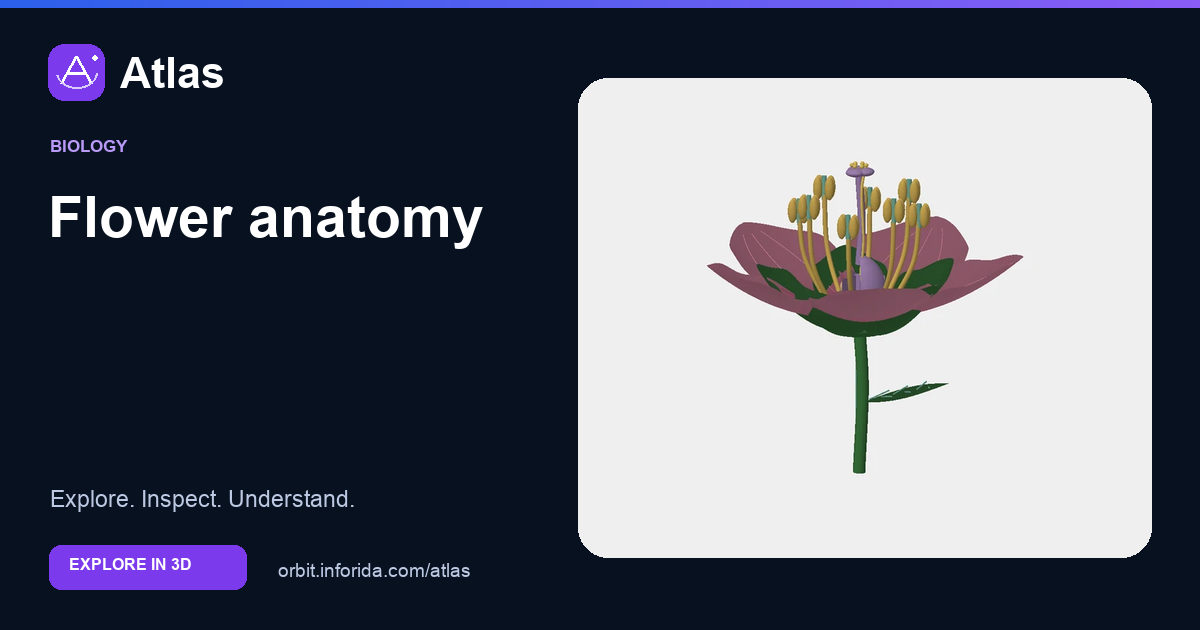
What you can learn
Distinguish pollination from fertilisation.
Anthers produce pollen; the filament supports an anther.
The stigma receives compatible pollen, and a pollen tube can grow through the style toward an ovule.
After fertilisation, ovules can develop into seeds and the ovary can develop into fruit.
Try an investigation
Locate anther, stigma and ovary. Describe why moving pollen to a stigma is only one step toward making a seed.
Check your understanding
Where is pollen produced?
Anther. Anthers contain pollen sacs where pollen develops.
What can a fertilized ovule develop into?
A seed. Following fertilization, an ovule can develop into a seed.
What distinguishes pollination from fertilization?
Pollination transfers pollen; fertilization joins gametes. Pollen transfer to a receptive stigma precedes the processes leading to fertilization.
Sources and model scope
The generic flower has cupped petals and sepals, attached fine venation and subtle surface shading, alongside illustrative anthers, pollen, ovary partitions and ovules. Five petals, eight stamens and a three-locular ovary teach organ relationships rather than identify a species. Veins, membranes and pollen are enlarged; surface shading is not measured tissue appearance. Pollen-tube growth, double fertilization and ovule-to-seed development remain static or absent.