Water cycle in 3D
Connect ocean, clouds, rain and flowing water. Explore the 3D model, inspect its parts and learn with guided explanations. Free on Atlas.
What you can learn
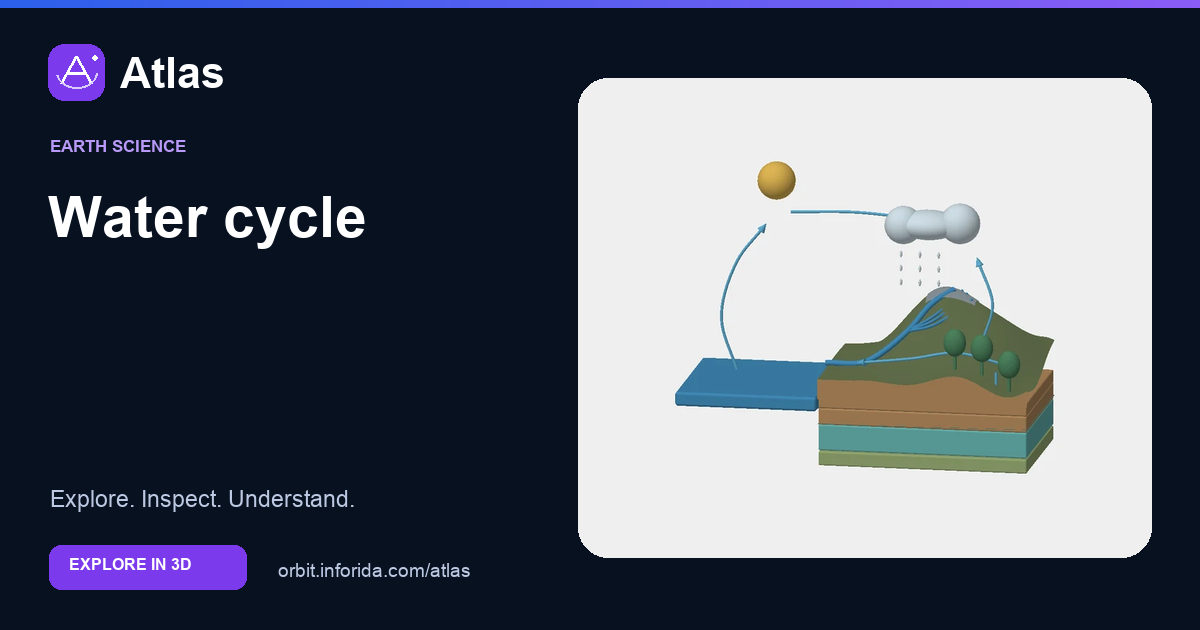
Trace water between stores and explain what drives its movement.
Solar energy supports evaporation, while transpiration releases water from plants.
Cooling can lead to condensation and cloud formation, followed by precipitation.
Gravity drives runoff and groundwater movement. Water can remain in oceans, ice, soil and underground stores for very different lengths of time.
Try an investigation
Follow two possible routes from a raindrop: one through a river and one into the ground. Explain why there is no single fixed circuit.
Check your understanding
What changes liquid water into water vapour?
Evaporation. Evaporation transfers water from a liquid surface into the air as vapour.
Cloud droplets form when water vapour…
Condenses. When moist air cools sufficiently, water vapour can condense into tiny droplets.
What helps water flow downhill across land?
Gravity. Gravity drives downhill flow. Water may also infiltrate into the ground.
Sources and model scope
Arrows show processes, not measured speeds or local forecasts. Groundwater occupies pores and fractures; it is not always an underground river.