Oxygen molecule in 3D
O₂ · Two oxygen atoms, connected. Oxygen gas participates in aerobic respiration and many oxidation reactions. Explore the 3D model, inspect its parts and learn with guided explanations. Free on Atlas.
What you can learn
O₂ · Two oxygen atoms, connected. Oxygen gas participates in aerobic respiration and many oxidation reactions.
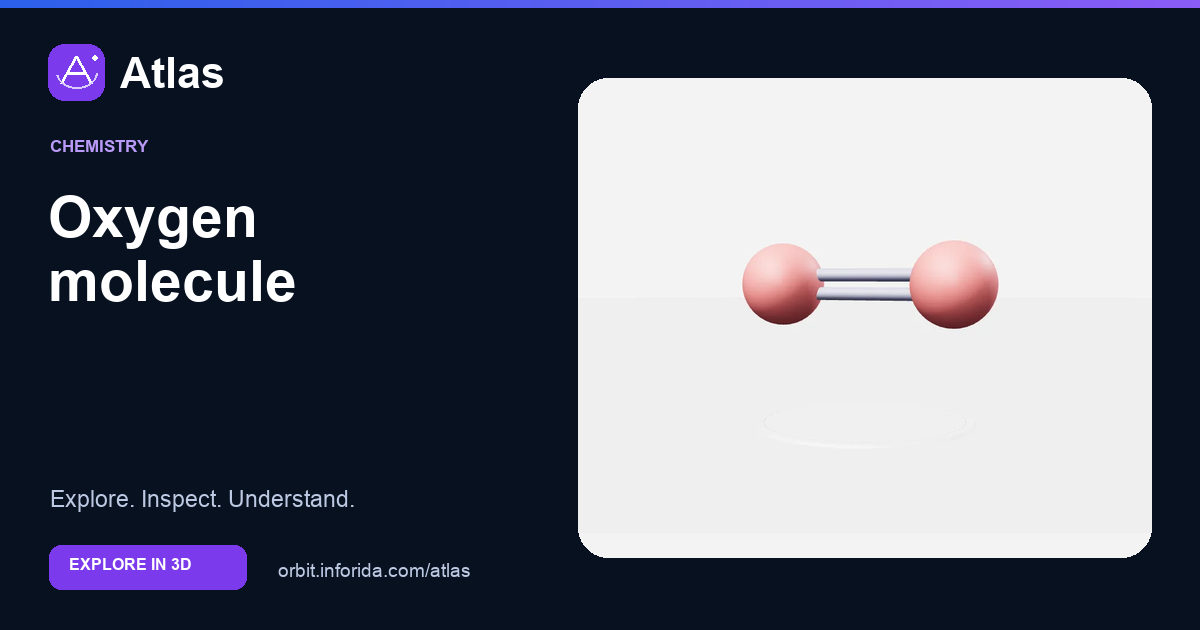
Count the 2 atoms. Match their element colours to the formula O₂.
Select a bond and identify the two atoms it connects. The simple Lewis structure of O₂ contains an oxygen–oxygen double bond. This picture alone does not explain oxygen’s magnetism.
Rotate the model to the side. A diatomic molecule has two nuclei along a line. There is no three-atom bond angle to measure.
Explain the difference between the atoms present and the molecule they form. O₂ is a molecule of an element because both atoms are oxygen. A molecule does not have to contain different elements.
Connect the model to daily life. Oxygen gas participates in aerobic respiration and many oxidation reactions.
What is missing from a ball-and-stick picture? Consider electron density, movement and interactions with nearby molecules.
Try an investigation
Count the 2 atoms. Match their element colours to the formula O₂.
Check your understanding
How many atoms are in one O₂ molecule?
2. Add the atom counts in O₂: one molecule contains 2 atoms. Subscripts belong to the element or group immediately before them.
How many different elements make up O₂?
1. Oxygen contains oxygen. Count element types separately from the total atom count.
What shape describes the two-atom molecule?
Linear. A diatomic molecule has two nuclei along a line. There is no three-atom bond angle to measure.
What bond is drawn in the simple Lewis picture of O₂?
A double bond. The simple Lewis structure of O₂ contains an oxygen–oxygen double bond. This picture alone does not explain oxygen’s magnetism.
Is O₂ a compound containing different elements?
No; it contains only oxygen. O₂ is a molecule of an element because both atoms are oxygen. A molecule does not have to contain different elements.
What do the sticks in this oxygen model represent?
Chemical connections between atoms. Ball-and-stick models help compare connections and spatial arrangement. Real molecules have electron distributions and vibrating nuclei, not coloured balls joined by rods.
Sources and model scope
Atomic centres use a PubChem computed 3D conformer, scaled for display.