Rocket in 3D
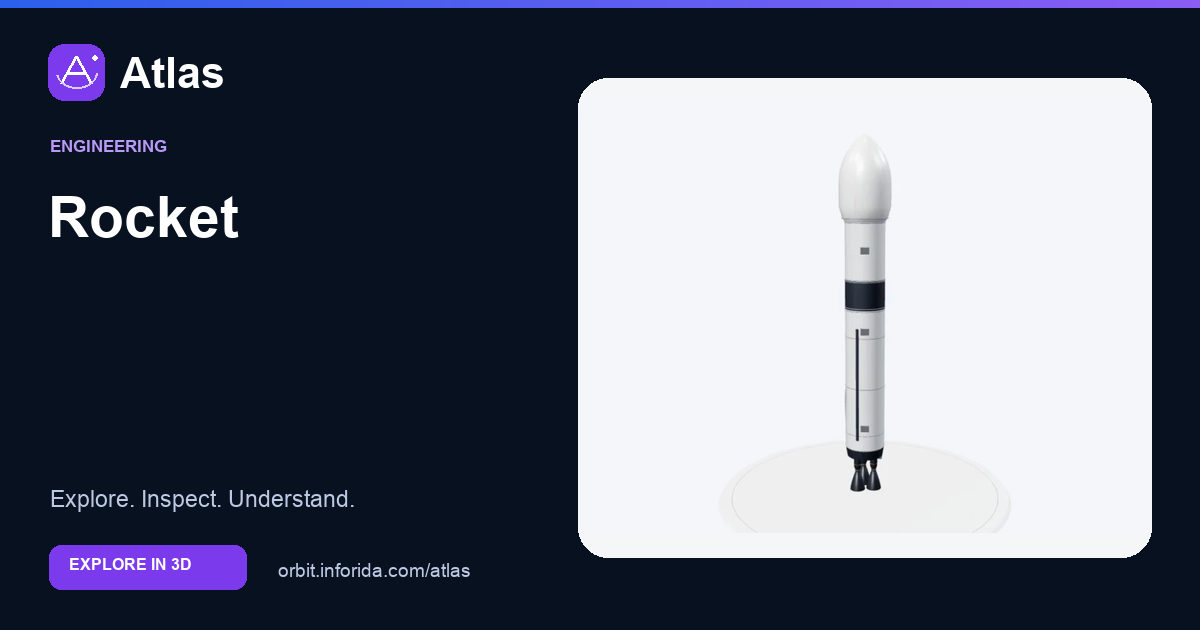
Inspect a liquid-fuel rocket from payload to nozzle. Explore the 3D model, inspect its parts and learn with guided explanations. Free on Atlas.
What you can learn
Explain propulsion without requiring surrounding air.
A liquid-propellant rocket carries fuel and oxidiser; they serve different roles.
Combustion produces hot gas, and the nozzle helps direct and accelerate the exhaust.
Payload, guidance and structure have roles separate from propulsion. Staging can discard hardware that is no longer needed.
Try an investigation
Identify payload, tanks and nozzle. Explain how exhaust moving one way changes the rocket’s momentum in the other direction.
Check your understanding
A rocket accelerates upward primarily by…
Expelling exhaust downward. Expelling exhaust gives it momentum; the rocket receives momentum in the opposite direction.
Why can a rocket engine work in a vacuum?
It carries propellant and expels mass. A rocket does not need air to push against. A chemical rocket carries fuel and oxidizer.
What does the payload section carry?
The equipment or spacecraft being transported. A payload may include instruments, satellites, cargo or a crewed spacecraft.
Sources and model scope
An original representative two-stage satellite launcher with separate skins, domed vessels, interstage, engine bells, feed routes and a stowed spacecraft. It is not a replica, measured flight article or construction design. Staging and flow are explained through selectable assemblies.