Carbon dioxide molecule in 3D
CO₂ · A straight molecule in the carbon cycle. Carbon dioxide is exchanged during respiration and photosynthesis and contributes to Earth’s greenhouse effect. Explore the 3D model, inspect its parts and learn with guided explanations. Free on Atlas.
What you can learn
CO₂ · A straight molecule in the carbon cycle. Carbon dioxide is exchanged during respiration and photosynthesis and contributes to Earth’s greenhouse effect.
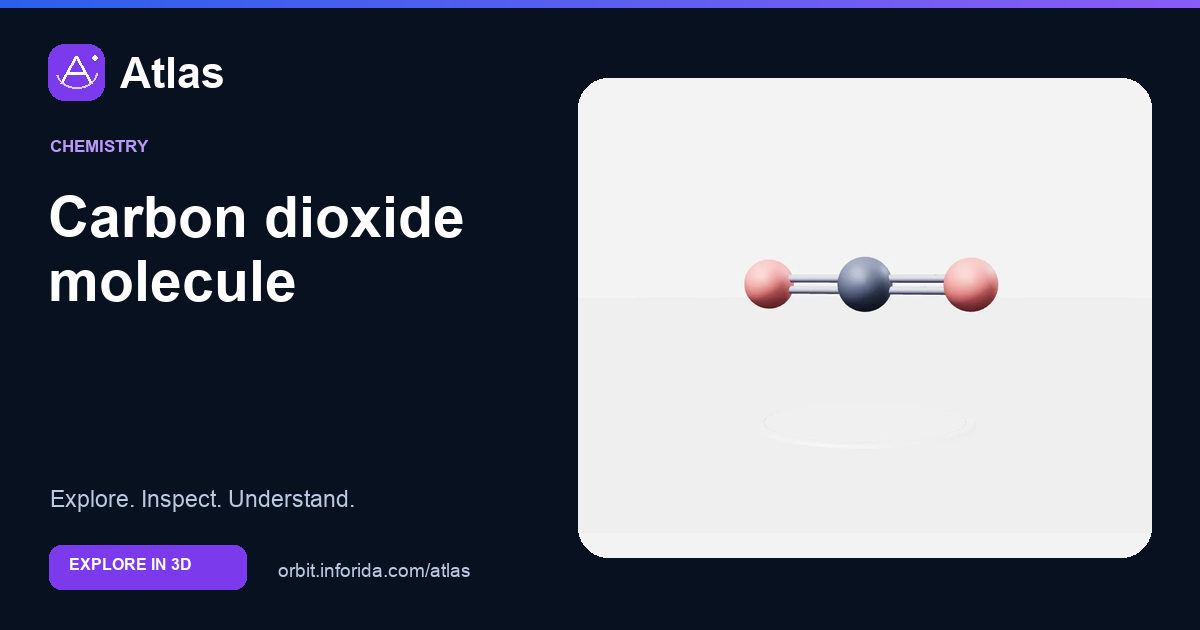
Count the 3 atoms. Match their element colours to the formula CO₂.
Select a bond and identify the two atoms it connects. A Lewis description of CO₂ has two carbon–oxygen double bonds.
Rotate the model to the side. The O=C=O arrangement is linear. The two bond dipoles cancel in an isolated, symmetric CO₂ molecule.
Explain the difference between the atoms present and the molecule they form. CO₂ contains polar bonds but its linear symmetry cancels their dipoles. Bond polarity and molecular polarity are different ideas.
Connect the model to daily life. Carbon dioxide is exchanged during respiration and photosynthesis and contributes to Earth’s greenhouse effect.
What is missing from a ball-and-stick picture? Consider electron density, movement and interactions with nearby molecules.
Try an investigation
Count the 3 atoms. Match their element colours to the formula CO₂.
Check your understanding
How many atoms are in one CO₂ molecule?
3. Add the atom counts in CO₂: one molecule contains 3 atoms. Subscripts belong to the element or group immediately before them.
How many different elements make up CO₂?
2. Carbon dioxide contains oxygen and carbon. Count element types separately from the total atom count.
What is the O–C–O shape?
Linear. The O=C=O arrangement is linear. The two bond dipoles cancel in an isolated, symmetric CO₂ molecule.
Which bonds connect carbon to the two oxygens?
Two double bonds. A Lewis description of CO₂ has two carbon–oxygen double bonds.
Why is an isolated CO₂ molecule nonpolar overall?
Its opposite bond dipoles cancel. CO₂ contains polar bonds but its linear symmetry cancels their dipoles. Bond polarity and molecular polarity are different ideas.
What do the sticks in this carbon dioxide model represent?
Chemical connections between atoms. Ball-and-stick models help compare connections and spatial arrangement. Real molecules have electron distributions and vibrating nuclei, not coloured balls joined by rods.
Sources and model scope
Atomic centres use a PubChem computed 3D conformer, scaled for display.