Solar System in 3D
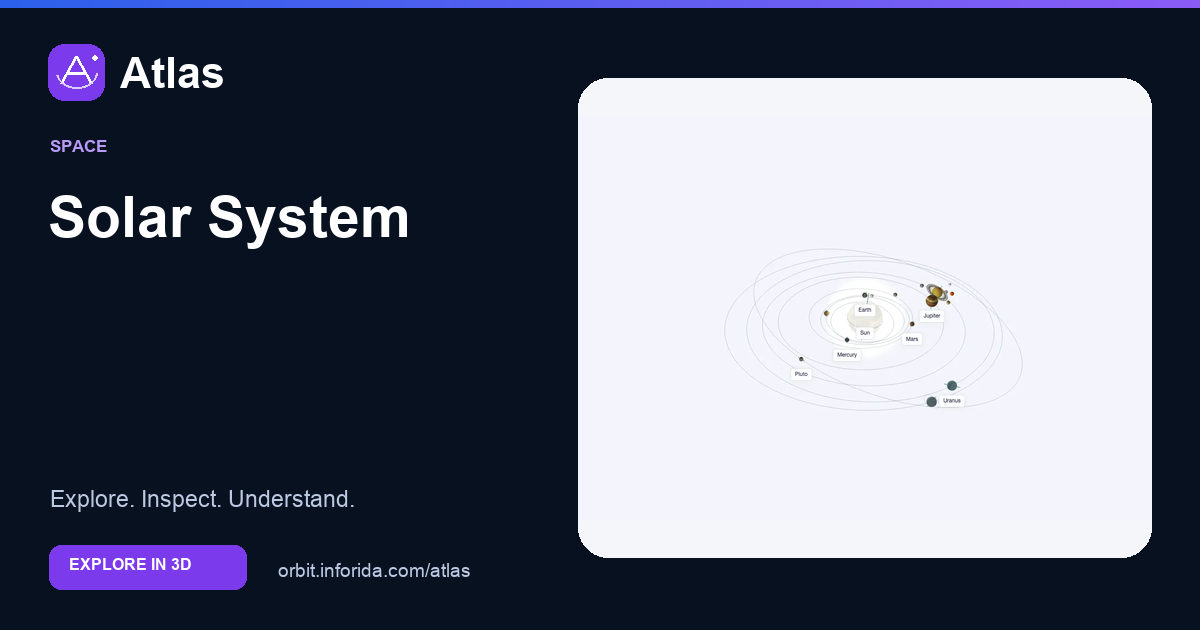
Travel between textured worlds. Explore planetary spin, tilted axes, moons, rings and paths around our star. Explore the 3D model, inspect its parts and learn with guided explanations. Free on Atlas.
What you can learn
Compare worlds without mistaking an illustration for a current sky chart.
Rocky planets, gas giants and ice giants have different bulk structures. Moons are worlds orbiting planets.
A planet rotates about its axis and revolves around the Sun; the two periods need not be similar.
Compressed distances and enlarged bodies make this overview legible. Relative-distance mode preserves orbital distance ratios, not body-size scale.
Try an investigation
Focus Earth and slow time. Then return to the overview and compare Mercury’s orbit with Neptune’s. Explain why one time speed cannot make both movements equally easy to see.
Check your understanding
Which planet follows the innermost orbit?
Mercury. Mercury follows the innermost planetary orbit; Venus and Earth orbit farther out.
What supplies most of the Sun’s energy?
Nuclear fusion in its core. Fusion joins light nuclei in the hot core, releasing energy that eventually escapes as radiation.
Which pair correctly describes a day and a year?
Rotation and revolution. Rotation is spin about an axis; revolution is travel around another body. Their periods differ.
What primarily causes Earth’s seasons?
Axial tilt changes sunlight angle and day length. Earth’s tilted axis changes the illumination of each hemisphere through its orbit.
Why can radar reveal Venus’s terrain?
It can probe through the cloud cover. Magellan radar measurements mapped the surface hidden beneath thick clouds; the coloured map is not a visible-light photograph.
A nearly 177° tilt shows that Venus’s spin is…
Opposite to the usual planetary direction. Its rotation is retrograde relative to the usual direction. The model uses a tilted axis with positive spin to represent this.
What are Jupiter’s visible bands?
Clouds shaped by atmospheric flow. Jupiter’s bands are cloud features in its deep atmosphere, not a solid surface.
Which moon is known for powerful volcanism?
Io. Tidal flexing supplies much of Io’s internal heat and drives volcanism.
An ocean beneath Europa’s ice means…
A promising environment to investigate, not proof of life. An inferred ocean makes Europa relevant to habitability research but does not establish that life exists.
Saturn’s rings are best described as…
Many independently orbiting icy particles. Ring particles orbit separately. The display enlarges their thickness and simplifies their fine structure.
The Cassini Division lies mainly between which rings?
A and B rings. The Cassini Division separates the bright B ring from the outer A ring. It is not completely empty.
Which planet’s axis is nearly along its orbital plane?
Uranus. Uranus has an axial tilt near 98°, giving it the familiar sideways orientation.
What mainly fills Titan’s observed surface lakes?
Methane and ethane. Titan’s cold surface supports liquid hydrocarbons; the lakes are not Earth-like water lakes.
Why is Pluto classified as a dwarf planet?
It has not cleared its orbital neighbourhood. Pluto is approximately round and orbits the Sun, but shares its orbital region with a substantial population of other bodies.
In relative-distance mode, what remains enlarged?
The displayed sizes of planets and moons. Distances use one relative heliocentric scale, while bodies remain enlarged so they can be found on a screen.
What does the simulated timeline represent?
Idealized teaching orbits from a reference epoch. The viewer uses a reference orbital shape and period. It does not reproduce perturbations, current cloud patterns or a precision sky prediction.
Sources and model scope
J2000 reference orbits omit perturbations and are not a live ephemeris. Axes, moon separations, ring shading and surface colours include disclosed teaching simplifications.