DNA double helix in 3D
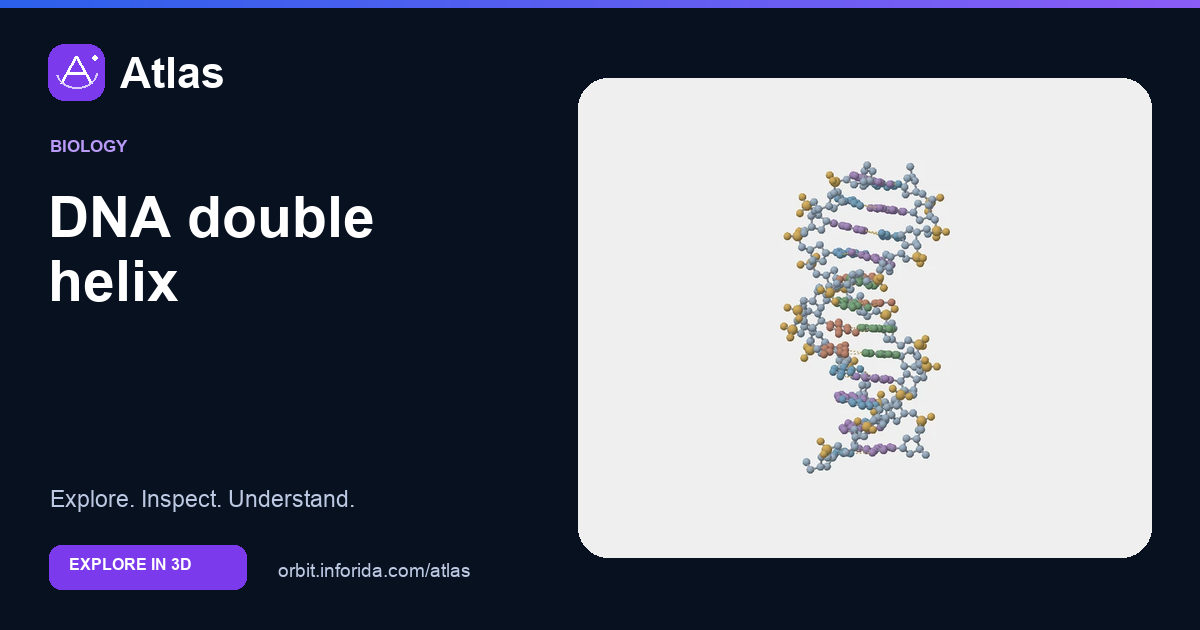
Inspect complementary base pairs and two antiparallel backbones. Explore the 3D model, inspect its parts and learn with guided explanations. Free on Atlas.
What you can learn
Connect complementary bases to a stable information-carrying structure.
Sugar-phosphate backbones run in opposite directions.
A pairs with T and G pairs with C in the usual DNA base-pairing model.
The base sequence stores information; the familiar helix shape alone does not specify a gene.
Try an investigation
Follow one backbone, then identify neighbouring base pairs. Predict the complementary sequence for A–G–T–C.
Check your understanding
Which base pairs with adenine?
Thymine. Complementary DNA pairing connects adenine with thymine and cytosine with guanine.
What forms the DNA backbone?
Alternating sugars and phosphates. Sugars and phosphate groups form each covalently bonded backbone.
What does antiparallel mean here?
The two strands run in opposite directions. One strand runs 5′ to 3′ while its paired strand runs 3′ to 5′.
Sources and model scope
This is a schematic helix, not an atomic-resolution structure or a person’s genome. Sticks and spacing simplify bonding.