Inside planet Earth in 3D
Open Earth’s layered interior and compare crust, mantle and core. Explore the 3D model, inspect its parts and learn with guided explanations. Free on Atlas.
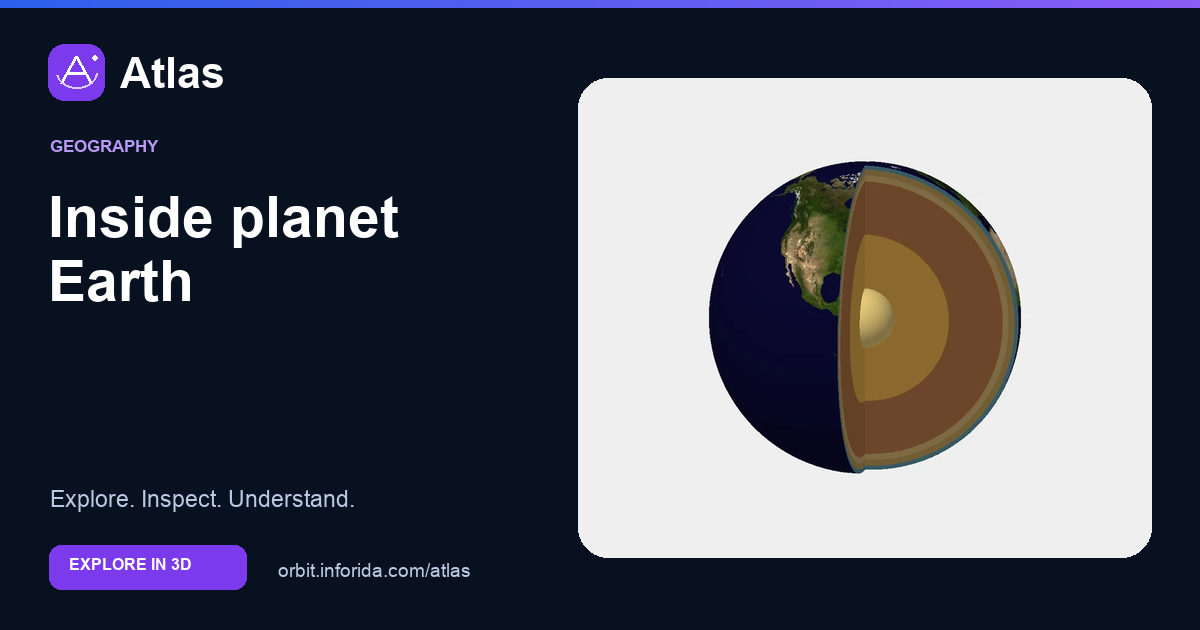
What you can learn
Distinguish chemical composition from mechanical behaviour.
Crust, mantle and core name major compositional divisions.
The lithosphere and asthenosphere describe mechanical behaviour; they are not simply alternate names for crust and mantle.
A liquid outer core surrounds a solid inner core. Pressure and temperature both influence the state of material.
Try an investigation
Separate layers and explain why the mantle can flow over long timescales without being a worldwide ocean of molten rock.
Check your understanding
Which major layer is liquid?
Outer core. The outer core consists of liquid metal; the inner core is solid under great pressure.
Is most of the mantle a liquid ocean of magma?
No, it is mostly solid rock. Most mantle rock is solid, but it can deform and flow slowly over geological time.
Why is the crust enlarged in this view?
To make a thin layer visible. The model exaggerates crust thickness for teaching; it is not a uniformly scaled cross-section.
Sources and model scope
The spherical cutaway has outer and inner layer surfaces, a solid inner core and a surface texture on the globe exterior. Approximate depth boundaries use a 6,371 km reference radius; crust thickness is exaggerated. Separate comparison strips distinguish crust and mechanical layers. Internal colours, surface appearance and convection symbols are explanatory, not a photograph of Earth’s interior. Seismic-wave propagation and a data-driven inference of layer composition are not simulated.