Nuclear structure & isotopes in 3D
Compare nucleons, isotope identity and nuclear binding. Explore the 3D model, inspect its parts and learn with guided explanations. Free on Atlas.
What you can learn
Compare nucleons, isotope identity and nuclear binding.
Count charge separately from mass number.
Compare twelve with fourteen.
Separate the nucleus from isolated nucleons.
Try an investigation
Count charge separately from mass number. Then compare carbon isotopes with nuclear binding. Explain what the visible structures show and what the model leaves out.
Check your understanding
What makes both shown carbon nuclei carbon?
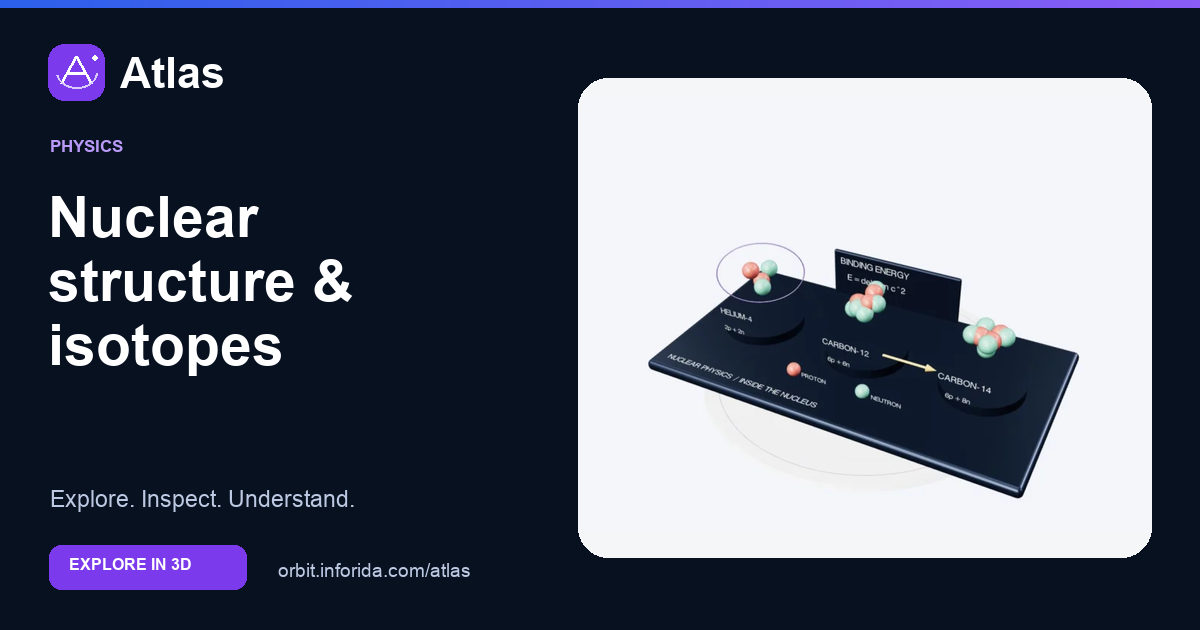
Six protons in each. Six protons in each. Both carbon examples contain six protons. Carbon-14 has two more neutrons than carbon-12, so they are isotopes of the same element. The arrow between them is a comparison and does not depict a nuclear reaction.
Carbon-14 has how many neutrons?
Eight. Eight. Both carbon examples contain six protons. Carbon-14 has two more neutrons than carbon-12, so they are isotopes of the same element. The arrow between them is a comparison and does not depict a nuclear reaction.
The visible particle colours are…
Teaching conventions. Teaching conventions. The red and green colour key distinguishes particle types. Real nuclei do not have painted component surfaces. The nearby atomic-extent ring is deliberately out of scale and is not an electron orbit in a modern atomic description.
Sources and model scope
Enlarged symbolic nucleon clusters for helium-4, carbon-12 and carbon-14. Not measured nuclear shapes, particle sizes or a model of nuclear reactions. Colours and positions are explanatory.