Electric car in 3D
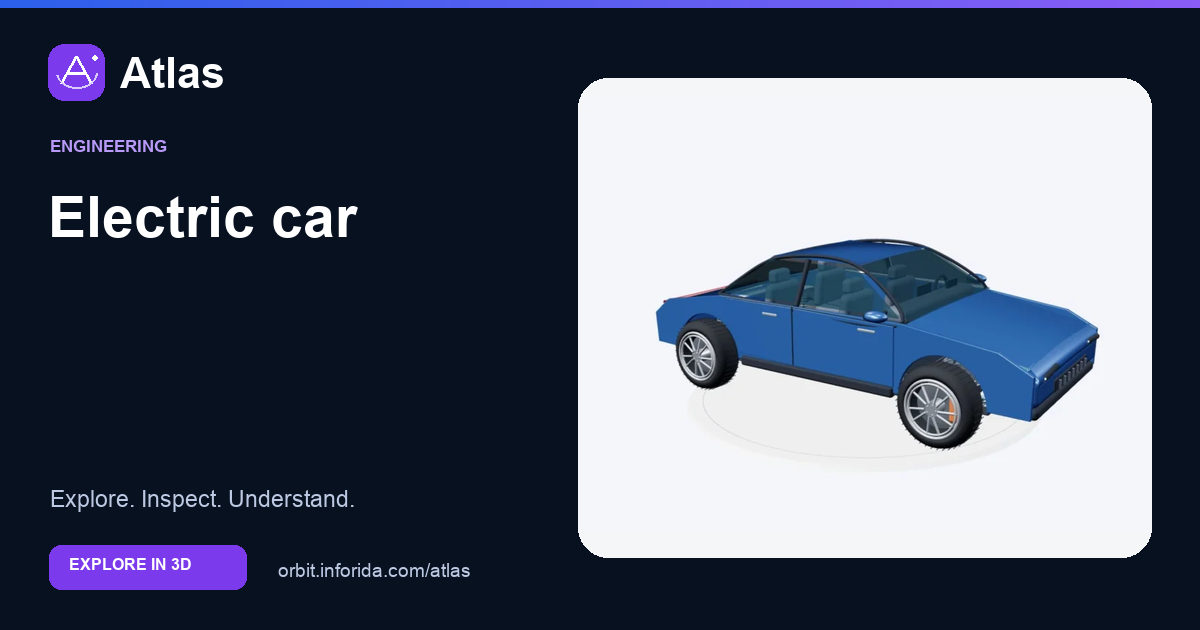
Reveal the battery, motor and drivetrain beneath the body. Explore the 3D model, inspect its parts and learn with guided explanations. Free on Atlas.
What you can learn
Connect electrical, mechanical and thermal systems.
Stored chemical energy supplies electrical energy from the battery. Power electronics control the motor.
Motor torque reaches the wheels through the drivetrain; friction between tyres and road accelerates the vehicle.
Cooling protects components. Regenerative braking can return some energy to the battery, alongside conventional friction brakes.
Try an investigation
Trace battery → power electronics → motor → wheels. Explain where energy goes during acceleration and why braking cannot recover all of it.
Check your understanding
What energy conversion happens in an electric motor?
Electrical to mechanical. An electric motor uses electrical energy to produce mechanical rotation.
What is regenerative braking designed to recover?
Some kinetic energy as electrical energy. During regenerative braking, the motor can act as a generator. Real systems still have losses.
Why does a car need tyres even when its motor is powerful?
Tyres provide contact and traction with the road. The tyre-road interaction allows driving, braking and steering forces to act on the car.
Sources and model scope
An original, representative electric fastback with shaped panels and an inspectable modular drivetrain. It is not a replica of a particular manufacturer or validated production CAD; dimensions, circuits and cell layouts are illustrative.