Human heart in 3D
Trace the path through a remarkable four-chambered pump. Explore the 3D model, inspect its parts and learn with guided explanations. Free on Atlas.
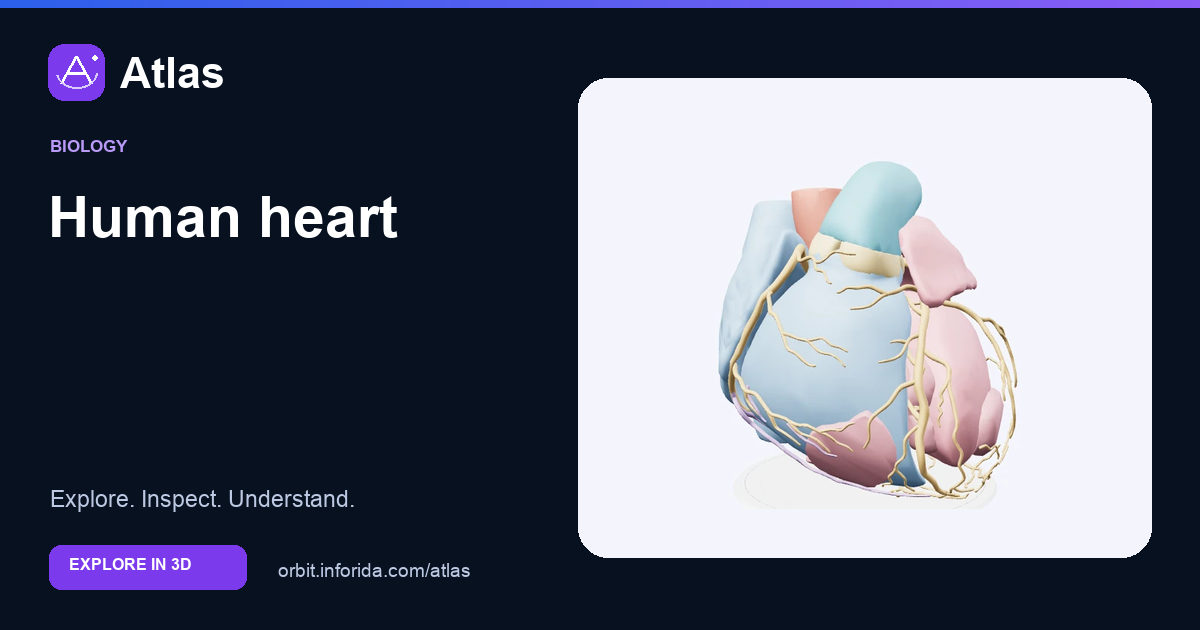
What you can learn
Trace pulmonary and systemic flow in the correct order.
Blood returning from the body enters the right atrium, then the right ventricle pumps it toward the lungs.
Blood returning from the lungs enters the left atrium; the left ventricle sends it through the aorta to the body.
Valves support one-way flow. The heart muscle receives its own supply through coronary vessels.
Try an investigation
Follow right ventricle → lungs → left atrium. Explain why a pulmonary artery carries less oxygenated blood even though it is an artery.
Check your understanding
Which chamber sends blood into the systemic circulation?
Left ventricle. The left ventricle pumps blood through the aorta into the systemic circulation.
What is the main role of heart valves?
Limit backward blood flow. Valves open and close as pressure differences change, helping blood move forward.
Where does blood leaving the right ventricle go next?
Toward the lungs. The right ventricle sends blood into the pulmonary arteries toward the lungs.
Sources and model scope
This is static anatomy. The model does not measure pressure, diagnose a heart condition or simulate valve timing. Red and blue are teaching conventions.