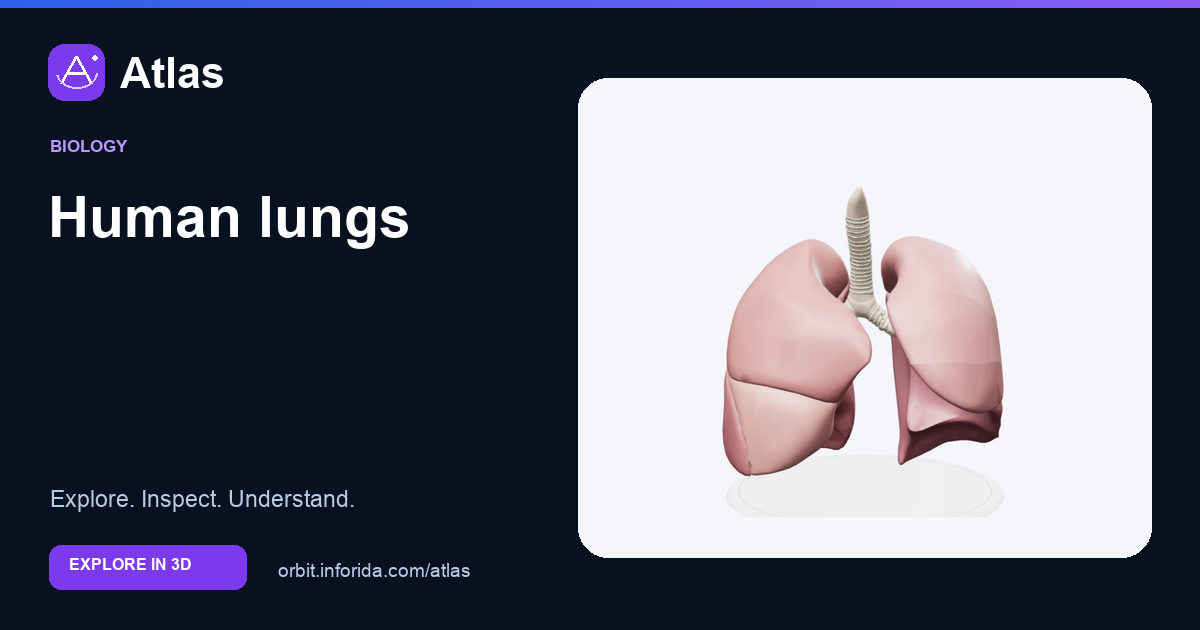
Human lungs in 3D
Follow branching airways into the lungs. Explore the 3D model, inspect its parts and learn with guided explanations. Free on Atlas.
What you can learn
Distinguish air movement from gas exchange with blood.
Air passes through the trachea and branching bronchi toward smaller airways.
At microscopic air sacs, oxygen and carbon dioxide diffuse between air and nearby blood.
Movement of the diaphragm changes chest volume and helps drive ventilation; breathing is not the same process as cellular respiration.
Try an investigation
Compare the main bronchi with smaller branches. Predict how many small exchange surfaces can provide more area than one large hollow space.
Check your understanding
Where does most gas exchange occur in healthy lungs?
Across the alveolar surface. Oxygen and carbon dioxide cross the thin alveolar-capillary barrier.
What is the job of the bronchi?
Conduct air into the lungs. The trachea branches into bronchi, which carry air into the lungs.
During quiet inhalation, the diaphragm generally…
Contracts and moves downward. Diaphragm contraction increases chest volume, helping air enter the lungs.
Sources and model scope
The default HRA reference contains 70 source lung, airway and supporting surfaces, separate from the legacy BodyParts3D view. An optional enlarged study adds an alveolus, respiratory-barrier layers, capillary routes and a pleural comparison, with ventilation, diffusion and perfusion distinguished. The inset is original illustrative geometry at a separate scale, not microscopic source data. Complete diaphragm relationships, breathing motion and gas-exchange rates are not simulated.