Human body in 3D
Body systems, connected. Explore male and female reference anatomy. Explore the 3D model, inspect its parts and learn with guided explanations. Free on Atlas.
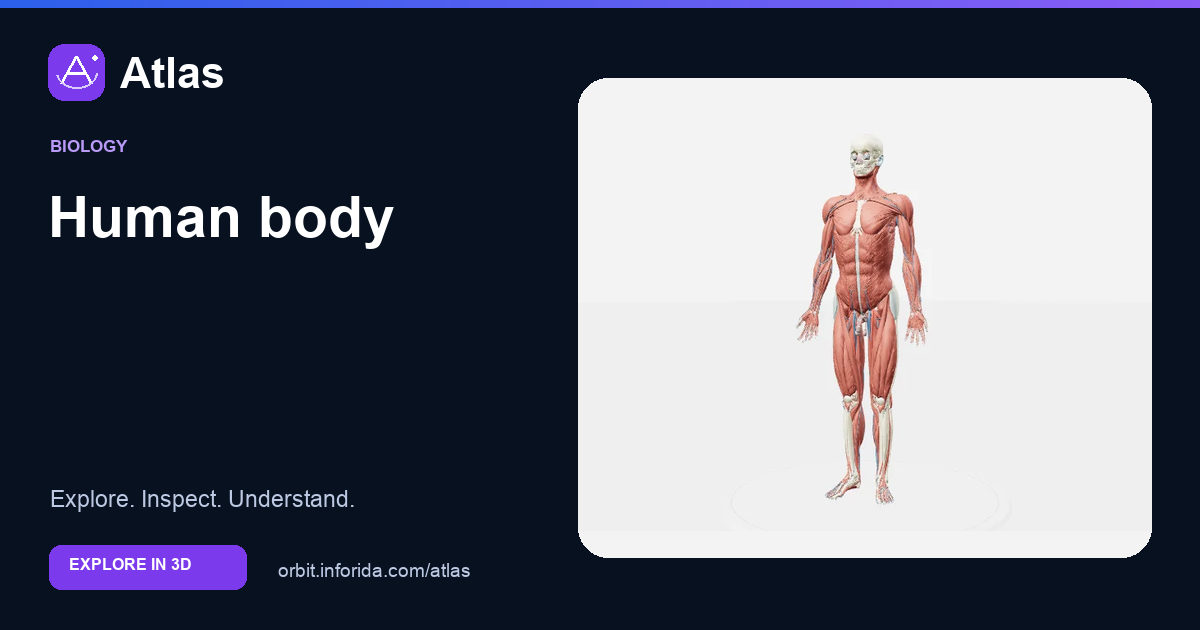
What you can learn
Explain how oxygen, nutrients and signals reach working tissues.
Follow air toward the lungs and blood from the heart toward the body. These are connected processes, but air and blood use different passages.
Hide muscles to locate the skeleton. Then restore muscles and consider how a pulling force can move a joint.
Compare male and female references by named structures. Shared organ functions remain similar even when source datasets have different coverage.
Try an investigation
Trace a breath, a nutrient and a movement command. Which systems must cooperate for each journey?
Check your understanding
Which pair works together to move the skeleton?
Muscles and bones. Skeletal muscles pull on their attachments to move bones at joints.
Which system carries signals between the brain and the rest of the body?
Nervous system. The nervous system carries and processes signals involved in sensation and movement.
What can these two reference bodies show?
Examples of human anatomy. Each dataset has a defined scope. Reference anatomy does not describe every person or every structure.
Sources and model scope
Source pieces are segmented surfaces, not a count of organs or a complete physiological simulation. Original female source coverage is partial. Added shared bone and muscle surfaces are labelled illustrative adaptations from BodyParts3D, not validated female-specific geometry.