Human muscles in 3D
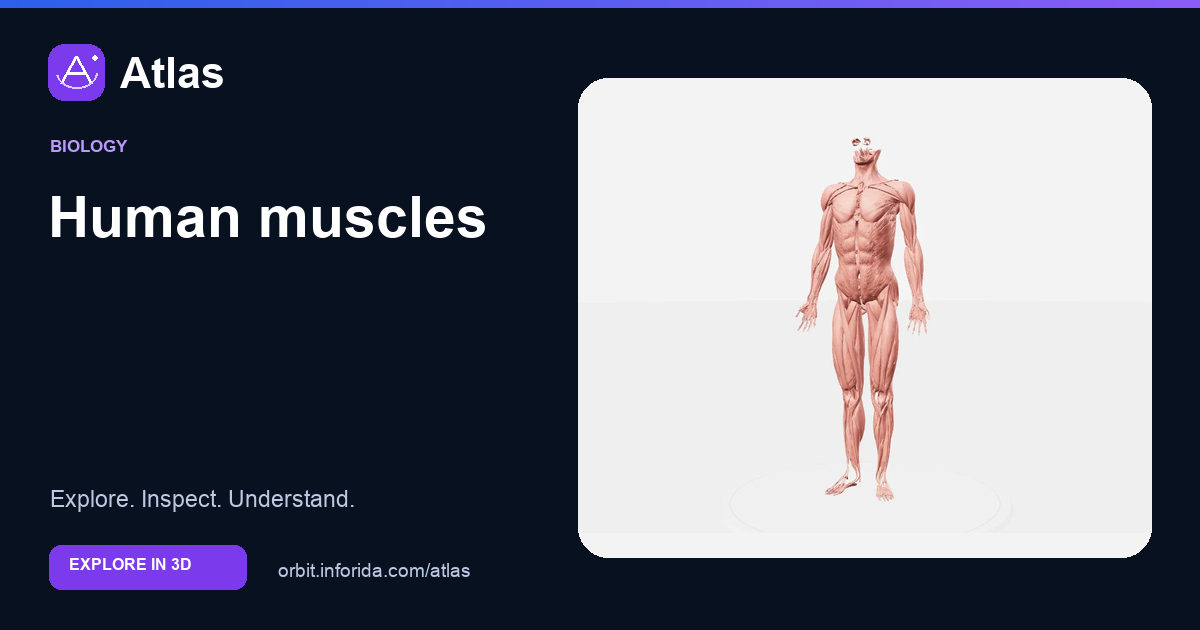
Explore named muscles and their relationship to movement. Explore the 3D model, inspect its parts and learn with guided explanations. Free on Atlas.
What you can learn
Explain why movement usually needs coordinated muscle groups.
Skeletal muscles transmit force to bones through connective tissues.
A contracting muscle pulls; it does not push a bone back to its original position.
Opposing groups can produce different joint movements, while stabilisers maintain posture.
Try an investigation
Find muscles on opposite sides of an upper arm. Predict which must shorten for bending versus straightening at the elbow.
Check your understanding
What happens when a skeletal muscle develops tension?
It pulls on its attachments. Muscles generate pulling forces that can move or stabilize attached bones.
What joins many skeletal muscles to bones?
Tendons. Tendons transmit muscle force to bone; they are connective tissue.
Can this surface model measure a person’s muscle strength?
No, it shows reference structure. Reference geometry shows anatomical relationships, not an individual’s functional strength.
Sources and model scope
The surfaces show anatomical position, not muscle activation, strength or a specific person’s movement. Attachment details vary by source coverage.