Kidneys & urinary system in 3D
Connect kidneys, ureters and bladder into one continuous pathway. Explore the 3D model, inspect its parts and learn with guided explanations. Free on Atlas.
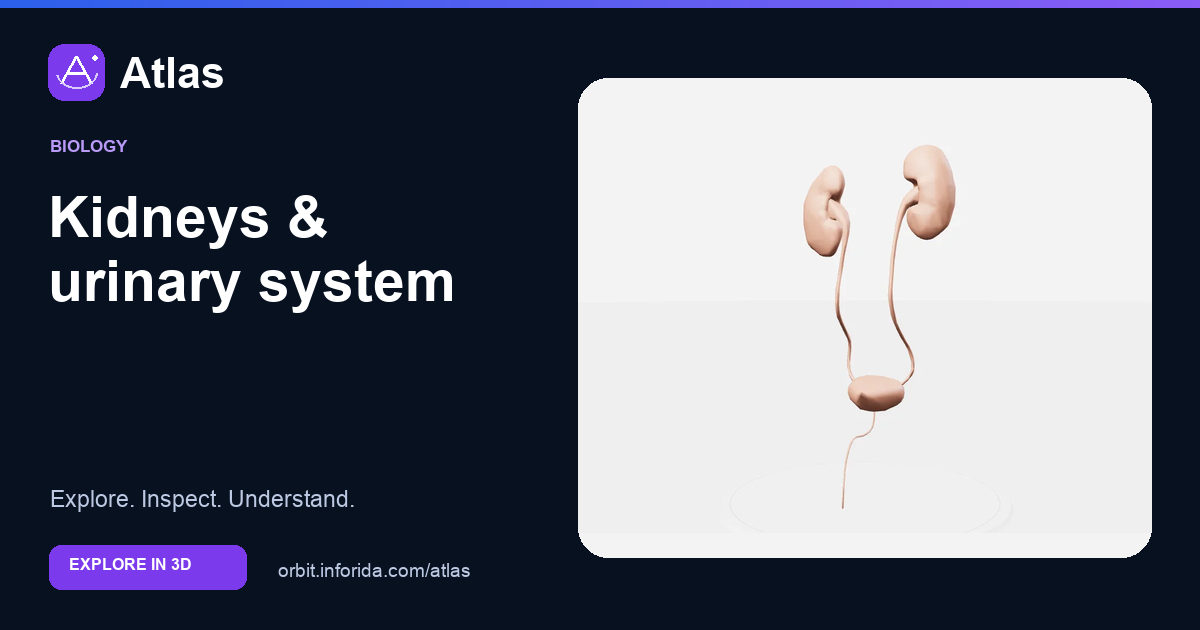
What you can learn
Separate urine production from urine storage.
Kidneys receive blood and adjust its composition through filtration, reabsorption and secretion.
Urine passes through the ureters toward the bladder.
The bladder stores urine; the urethra carries it out. Kidney function also contributes to fluid and electrolyte balance.
Try an investigation
Follow kidney → ureter → bladder. Explain why a full bladder does not mean the bladder filtered the blood.
Check your understanding
Which organs filter blood to form urine?
Kidneys. Kidneys filter blood and adjust the amounts of water and dissolved substances retained.
What carries urine to the bladder?
Ureters. A ureter carries urine from each kidney to the bladder.
What does the bladder primarily do?
Stores urine. The bladder holds urine before it leaves the body through the urethra.
Sources and model scope
The six BodyParts3D source organ surfaces remain unchanged. A separate enlarged study opens a renal corpuscle and filtration barrier, follows a simplified nephron into a collecting duct, and compares filtration, reabsorption, secretion and excretion. The inset is original illustrative geometry, not a microscopic scan registered inside the kidneys. Full renal circulation, cortical/medullary placement and fluid/solute transport are not reconstructed or simulated.