Digestive system in 3D
Follow food through the tract and meet the organs that help digestion. Explore the 3D model, inspect its parts and learn with guided explanations. Free on Atlas.
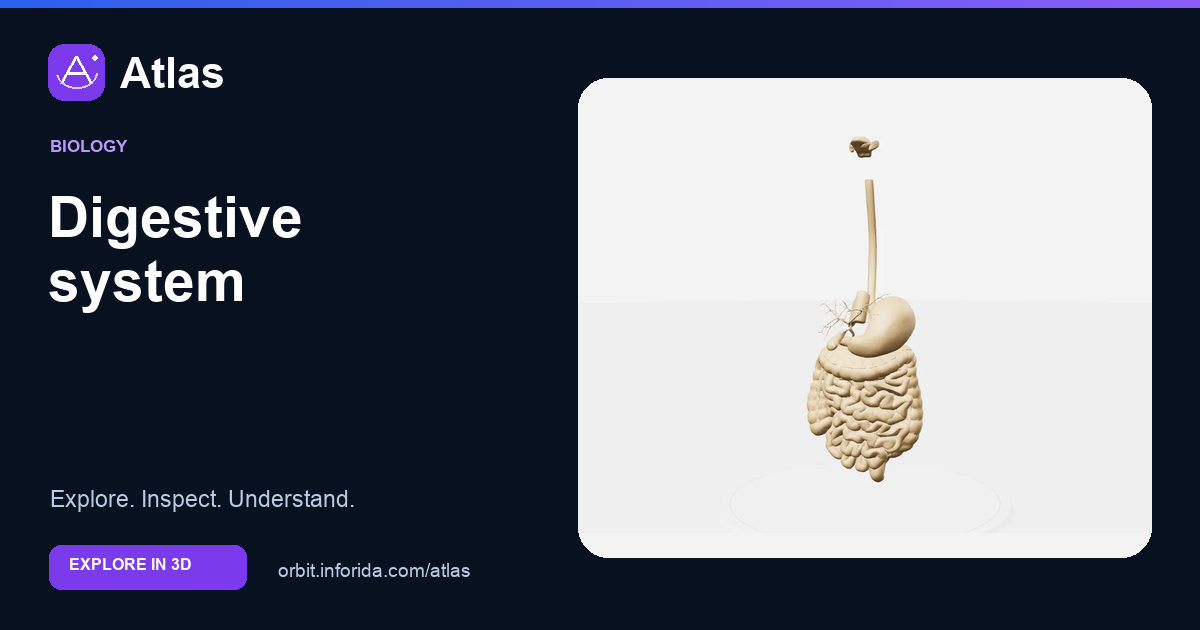
What you can learn
Distinguish the route of food from the role of accessory organs.
Food passes along the mouth, oesophagus, stomach and intestines.
Liver, gallbladder and pancreas add substances that support digestion, but food does not travel through these organs.
The small intestine is a major site of nutrient absorption; the large intestine recovers water and handles remaining material.
Try an investigation
Trace the continuous food passage. Then locate an organ outside that passage and explain what it contributes.
Check your understanding
Where does most nutrient absorption occur?
Small intestine. The small intestine provides a large surface for absorbing digested nutrients.
Which organ produces bile?
Liver. The liver produces bile; the gallbladder stores and releases it.
What moves food along the digestive tract?
Coordinated muscular contractions. Peristalsis is a coordinated pattern of contractions that moves contents along the tract.
Sources and model scope
Surface meshes omit most microscopic villi, enzymes and transport mechanisms. Separation of parts is for viewing, not a physical space inside the body.