Human skeleton in 3D
Bones, joints and the framework that makes movement possible. Explore the 3D model, inspect its parts and learn with guided explanations. Free on Atlas.
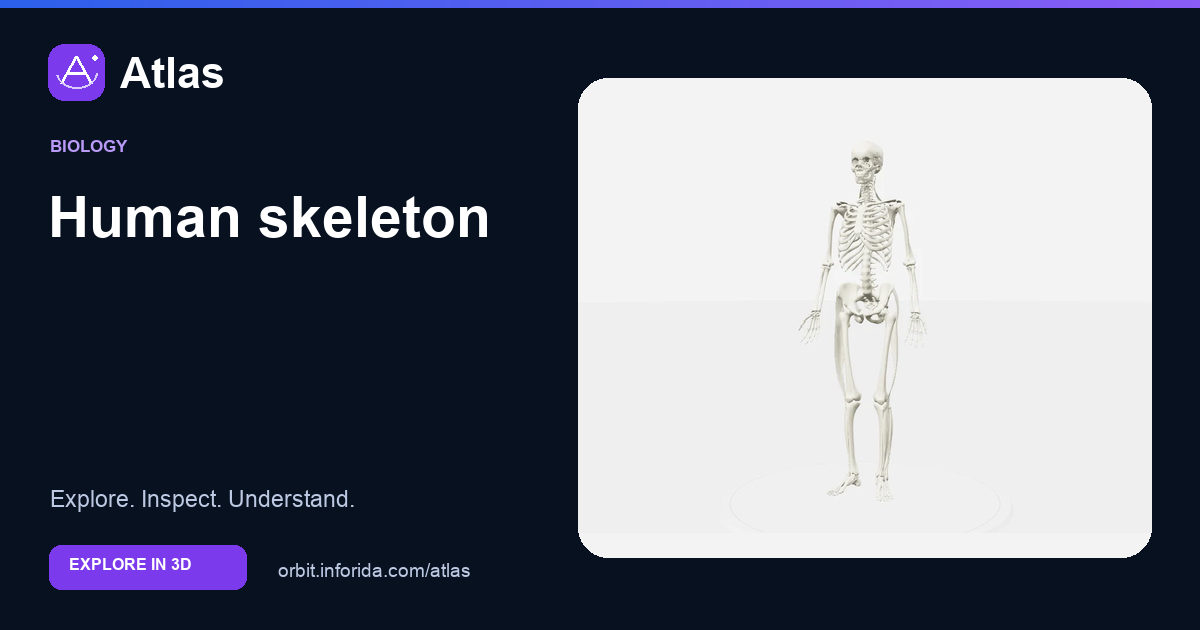
What you can learn
Relate bone shape and position to mechanical roles.
The skull, vertebral column and rib cage are central protective structures.
Limb bones and girdles link movement to the trunk.
A joint brings bones together; ligaments connect bones, while tendons transfer muscle pull to bone.
Try an investigation
Compare a femur with a rib. Identify a shape difference and propose how it supports each bone’s role.
Check your understanding
What do skeletal muscles do to move bones?
Pull through their attachments. Muscle tension acts through attachments, producing movement at joints.
Which structure surrounds the spinal canal?
Vertebral column. Vertebrae form the column around the canal containing the spinal cord.
Why do bones have different shapes?
They support different mechanical roles. Bone shape relates to support, protection, joint movement and attachment forces.
Sources and model scope
A dataset may split or omit structures. Its mesh count is not a person’s bone count, and surface colours do not show bone density.